AI ASMR Video Ideas: 12 Formats You Can Generate Tonight
Twelve AI ASMR video ideas you can paste straight into the editor — sensory triggers, domestic rituals, sound-prop loops, and travel scenes, each one built around a single sound and a single frame.
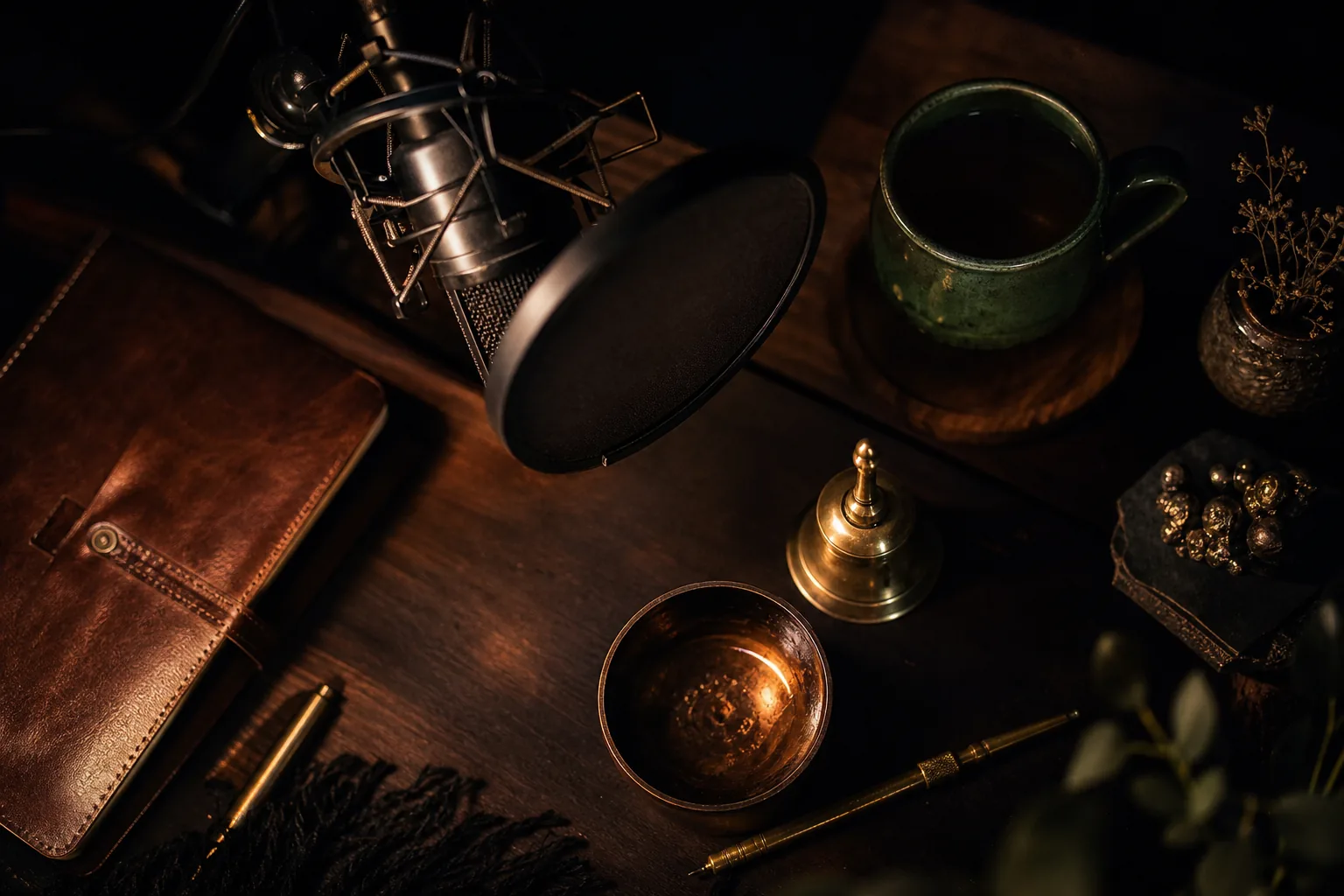
AI ASMR video ideas keep falling into two ditches online: either a wall of tutorials about which microphone to buy, or a list of vague mood words like cozy, rainy, aesthetic. Neither helps if you're trying to ship a short tonight. The format is doing all the work in ASMR — the trigger you pick, the frame you lock the camera on, and the way the loop ends decide whether the video is finishable, scrollable, and rewatchable.
Below are 12 short-video formats — each a complete recipe — that run cleanly through an AI generator + whispered voiceover + subtitles. You can paste any of them into the Story Into Video editor, let the default model handle the visuals, and have a finished 30–90 second short by tonight. Every format ends with a one-line Key sound and Key visual so you know exactly what to lock onto, and a button that opens the editor in a new tab with the recipe already filled in.
Sensory-trigger ASMR ideas
The classic ASMR formats all live here. Whisper, tap, personal attention — the three triggers that built the genre. They work because the camera is closer than a stranger should ever be, and the sound is louder than the picture should let it be. Lean into both.
1 — Whispered close-up
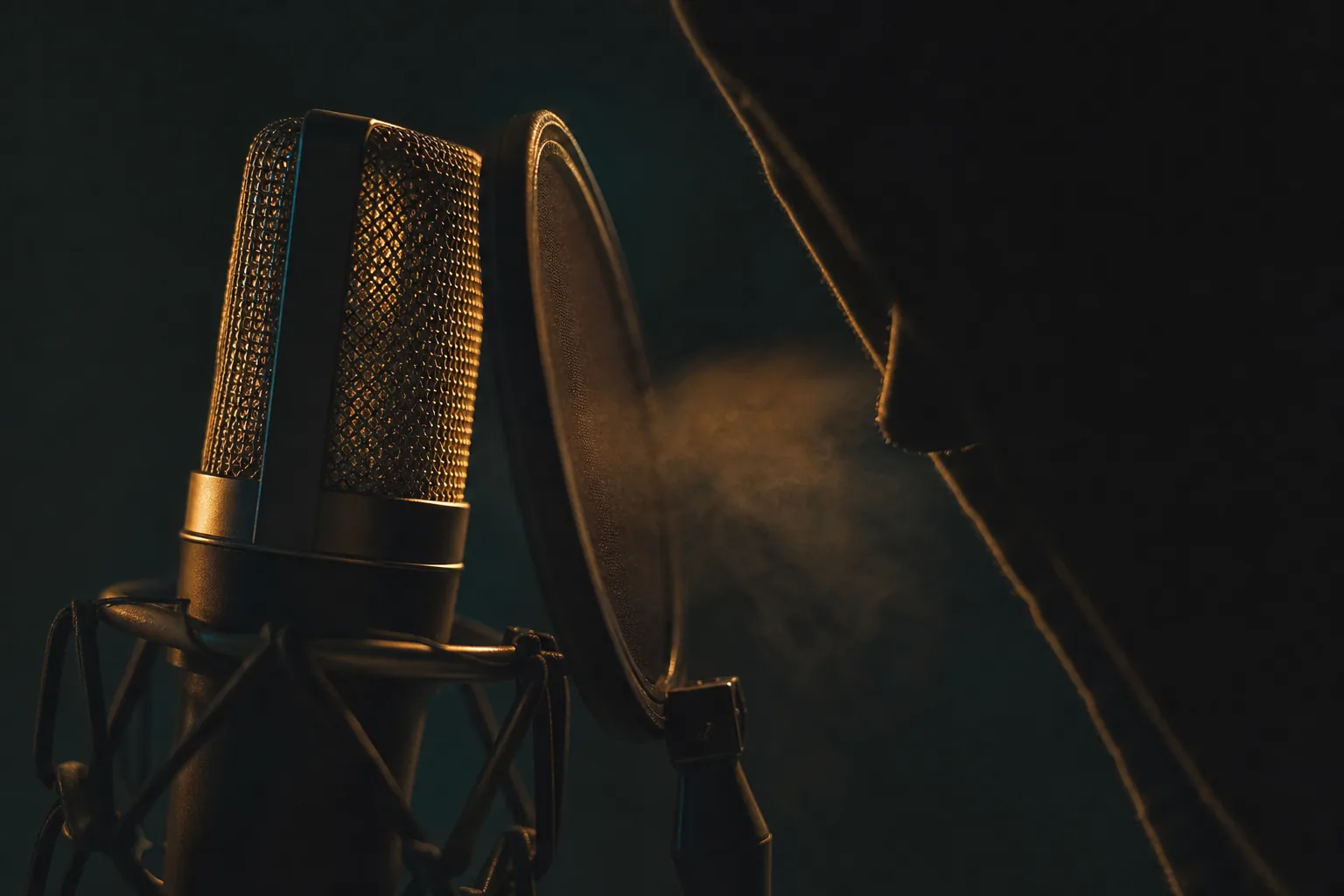
The frame is a single studio condenser microphone in extreme close-up, soft mesh pop filter floating just left of center. A hooded silhouette leans in from screen right — close enough that the breath fogs the metal grille — but the face stays out of frame the whole time. The video never cuts. Whatever moves, moves at the speed of someone trying not to wake a sleeping room.
The sound carries the entire video. A whispered monologue runs the full duration, brushing two or three words against the mic per second, with the kind of sss and kkk consonants that pop softly into the pop filter. Underneath that, a single low warm room tone, never louder than the whisper. The picture is just there to give the ear permission to relax.
End the video where you started: same angle, same rim light, the silhouette pulling back half an inch as the last whispered word fades. The viewer should be able to loop it without noticing the seam.
Key sound: a continuous whispered monologue, two-to-three words a second, breath audible between phrases. Key visual: a studio condenser microphone in close-up with a soft hooded silhouette leaning in from one side, no face shown.
2 — Tapping on objects
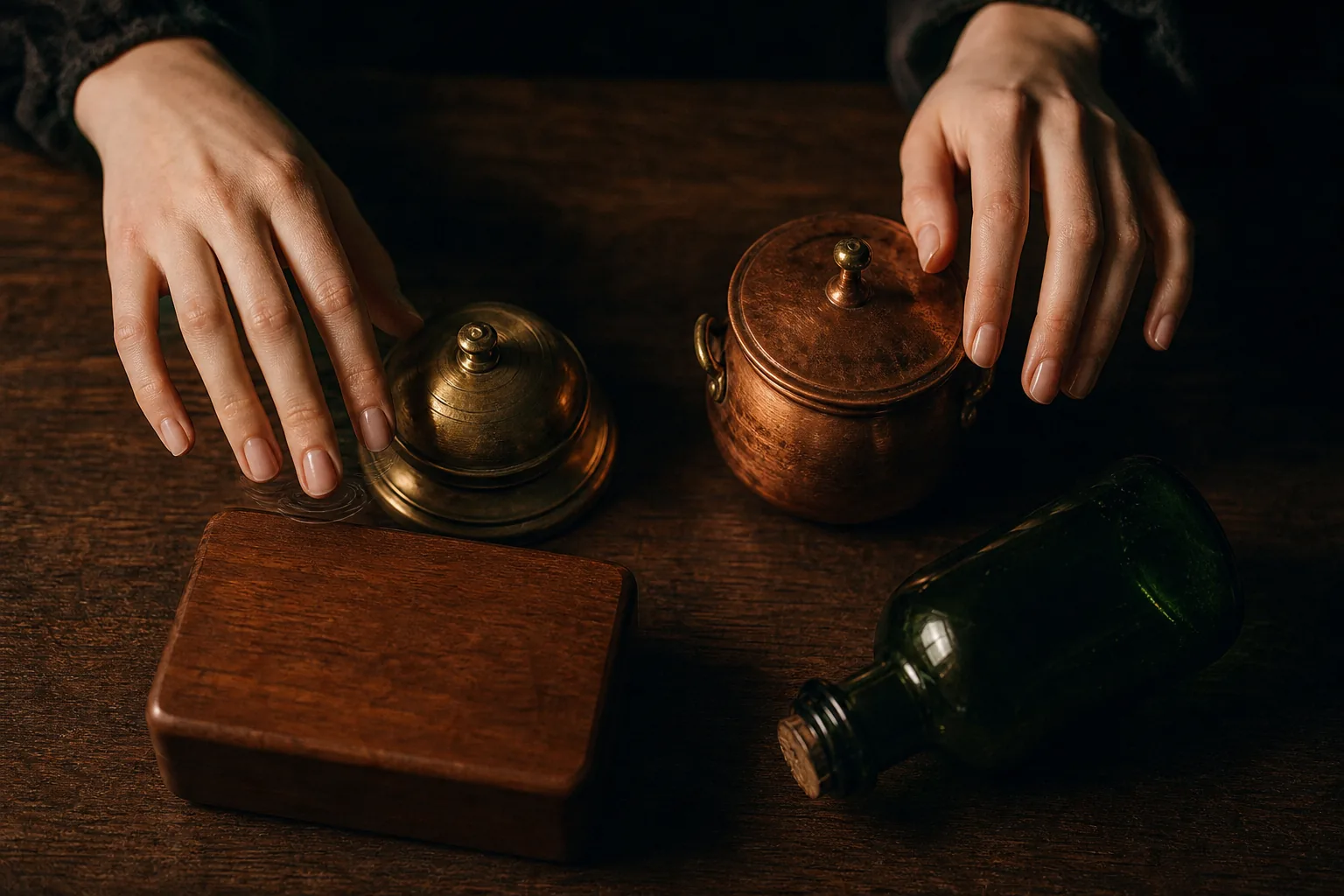
Lay four small objects in a quiet line on a dark walnut tabletop: a brass bell, a copper-lidded pot, a smooth wooden box, a thick green glass bottle. The camera lives directly above them, locked off. A pair of slender hands enters from below the frame and moves left to right, tapping each object with a different finger and a different rhythm — index on the brass, middle on the copper, thumb on the wood, ring on the glass.
The sound design is the whole pitch of the video. Each material gets one identifiable timbre: bright metallic ping, dull warm thunk, hollow plywood knock, glassy bell chime. Stagger the rhythms so they layer rather than collide — brass on the downbeat, glass on the offbeat, wood as the slow pulse underneath. No music. Just the four sounds and the room.
Loop the sequence twice and end on the same fingertip first touched: brass, frozen mid-tap. Cut to black on the resonance, not on the hit.
Key sound: four distinct tap timbres (brass, copper, wood, glass) layered into a slow rhythm. Key visual: top-down view of a row of small objects on dark wood, slender fingers entering from below.
3 — Personal-attention POV
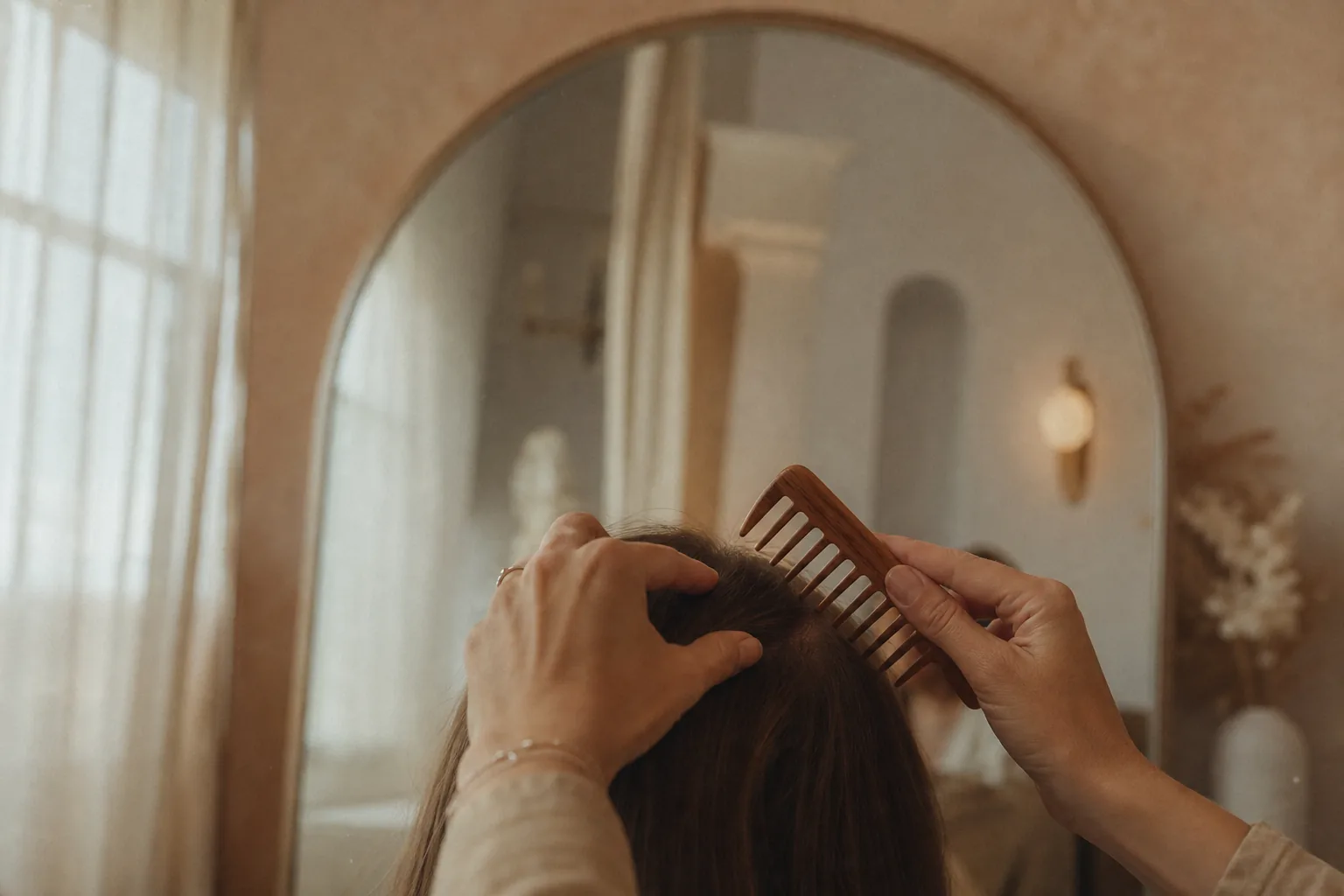
The camera is the viewer's eyes. The frame is a salon mirror in soft natural daylight, and the only person in it is from the shoulders up — but never with a clear face, because the angle keeps the head tilted just barely down. A stylist's hands enter from off-camera and begin a slow, deliberate routine: parting the hair near the temple with a wide-tooth wooden comb, smoothing it back, adjusting a single strand with two fingertips.
Audio is the close, soft shh of comb teeth moving through hair, the small dry click of wood touching wood as the comb is set down on a porcelain dish, the tiny inhale of someone concentrating. Speech, if any, is one or two words at a time, no full sentences — like this, almost, okay. The viewer should feel the personal attention as the sound, not as a script.
End on a single moment of stillness: the comb laid down, the hands withdrawing past the edge of frame, the hair settling. Hold three seconds of silence with just the room tone, then cut.
Key sound: comb teeth in hair, soft wood-on-porcelain clicks, breathy half-words. Key visual: a mirror POV with shoulders and partial head in soft daylight, hands working from off-camera, no clear face.
Domestic-ritual ASMR ideas
Ritual is the second engine of ASMR. The viewer leans in because someone on the other side of the screen is paying very close attention to something small. Hands, water, fabric, the same steps in the same order every time.
4 — Hands-only cooking ASMR
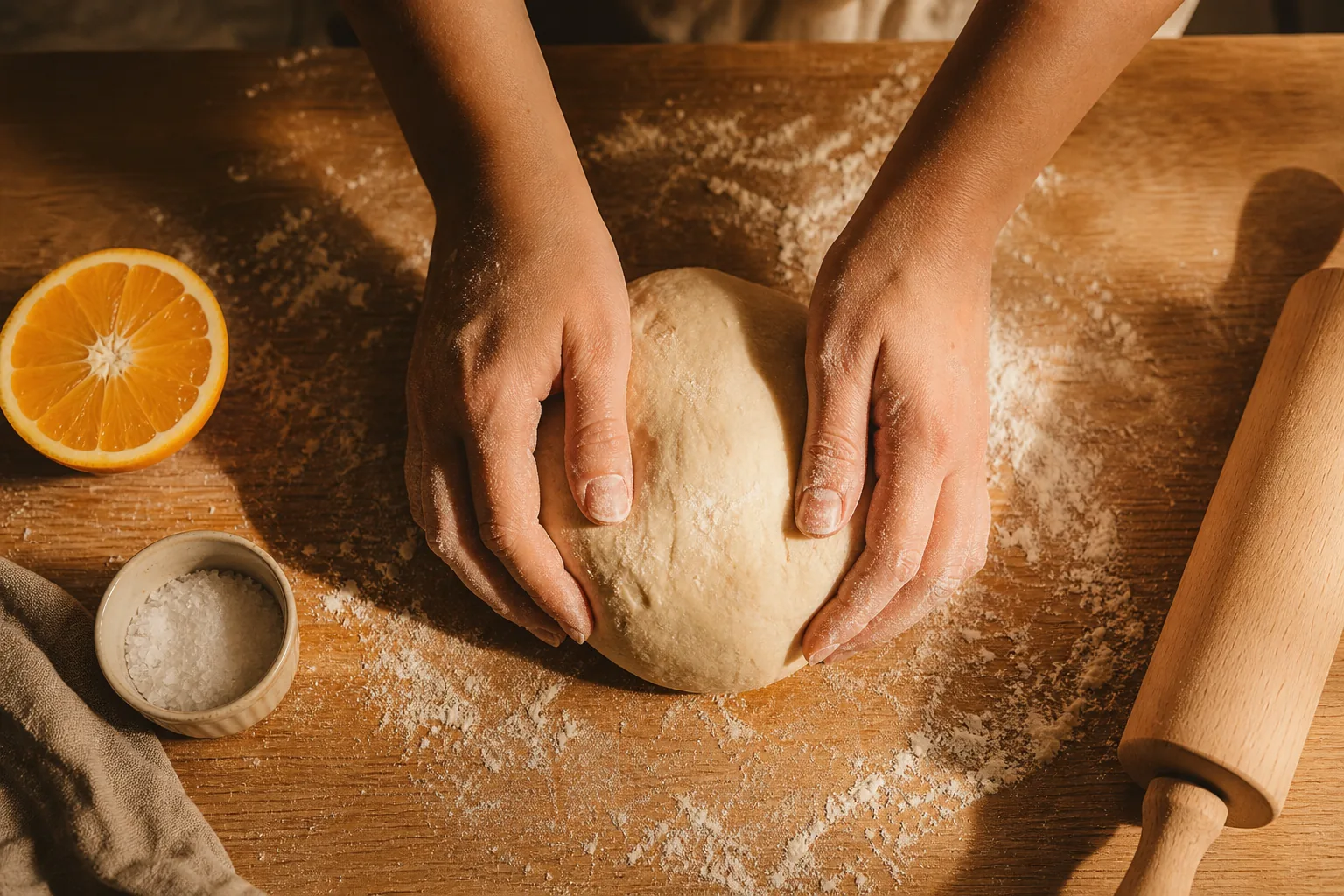
A pure overhead shot of a flour-dusted oak board. A pair of bare hands, sleeves pushed up to the elbow, kneads a soft ball of dough at the center of frame, with a halved orange resting at top-left and a small ramekin of sea salt at top-right. The hands never stop moving. The face never enters.
Build the audio as a layered routine: the dry rasp of flour against wood, the wet stretch of dough being pulled and folded, the bright crisp slice when a knife eventually halves the orange, the soft tap of salt grains being pinched and scattered. No music, no narration. The whisk of an oven door opening in the distance is the only event sound.
End by lifting the formed dough into a waiting bowl, dusting one final pinch of flour over the top, and pulling the hands out of frame. Hold the empty board for a beat — flour drifting, settling — before fade-out.
Key sound: hand-on-dough stretching, flour scraping wood, knife through citrus, salt grains scattering. Key visual: top-down overhead of bare hands kneading dough on a flour-dusted board, no face.
5 — Page-turning library

The setting is a long wooden reading table in a quiet vintage library at golden hour. Tall mahogany shelves fill the background. A teal-green shaded brass lamp glows on the right. The camera holds a single slow dolly across the table — past an open hardcover book mid-page, past a fountain pen resting on a half-filled notebook, past a small porcelain teacup steaming faintly.
The sound is the entire library breathing. A page turns every six or seven seconds with a long fibrous shhh. A nib scratches a single careful line across paper. The teacup is set back down on its saucer with a porcelain tap. Underneath all of it, a low room tone — distant footsteps far down a hall, never close enough to be present.
End by returning the camera to the open book and holding the frame still. The viewer's eye should fall on the page, but the text should never be quite readable.
Key sound: long slow page turns, fountain pen scratching, porcelain on porcelain. Key visual: a vintage library reading table with an open book, a pen, and dust drifting in low sunlight.
6 — Tea ceremony slow
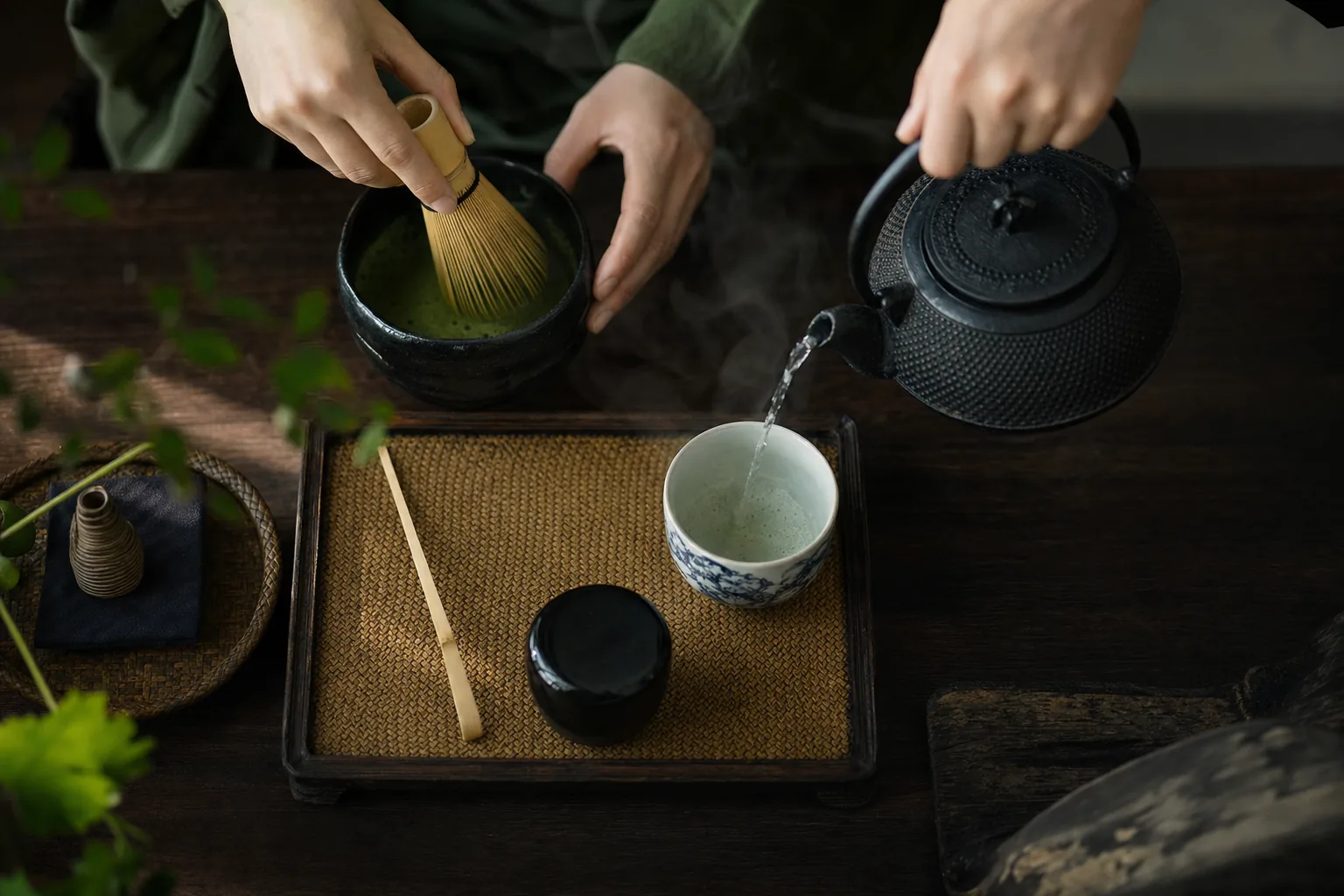
Pull an overhead camera straight down onto a tea ceremony in slow progress. A pair of hands works inside a tight composition: a black ceramic chawan with bright matcha-green powder, a bamboo whisk, a slim bamboo scoop, a cast-iron tetsubin on the right. A single ribbon of steam rises constantly out of the kettle's spout. The hands never rush. The frame never moves.
The audio is the ceremony in miniature. Water being poured from the tetsubin into the bowl — a high thin stream, then a thicker fall, then a trailing drip. The bamboo whisk moves in a fast m-shape against the inside of the chawan with a soft electric whir. A wooden lid lifted and replaced on the matcha tin. The whole sequence runs about sixty seconds.
End on the finished bowl held still under the camera, foam settled, a single drop sliding down the outer wall of the chawan. Cut to black on the drip, not on a sip.
Key sound: water pouring into ceramic, bamboo whisk against the bowl, wooden lid replaced. Key visual: overhead composition of a black chawan, bamboo whisk, cast-iron tetsubin with rising steam.
Sound-prop loops
When the trigger is a single ambient sound, the picture's only job is to be honest about where the sound comes from. Show the surface. Show the source. Then loop.
7 — Rain on different surfaces
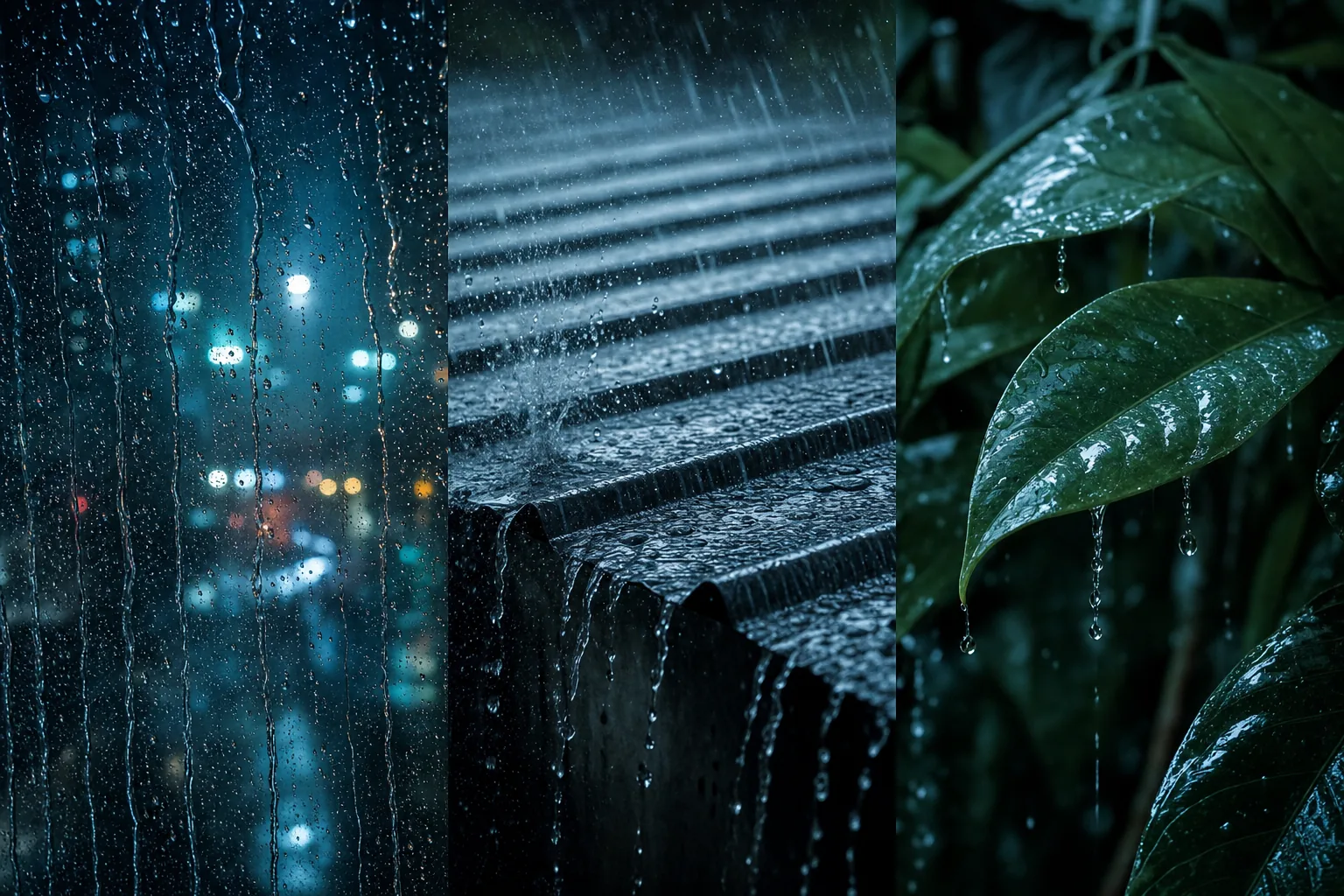
Cut the video into three vertical thirds and use each as a separate rain surface. Left third: fat raindrops sliding down a clear window pane, a blurred city night behind them. Middle third: rain pounding a corrugated metal roof in close-up, water sheeting off in straight bright lines. Right third: rain dripping off broad green tropical leaves, each leaf bending under the weight and snapping back.
The audio layers all three surfaces, but at different mix levels so the viewer's ear can pick one and rest there. The window thread sits mid-low and steady. The metal roof rings bright and percussive on top. The leaves drip slow and irregular underneath. No music. No human sound.
The video doesn't need an ending — it needs a loop. Match the last second of audio to the first second of audio so a viewer who sits with the tab open hears one continuous rainstorm.
Key sound: three layered rain surfaces (window glass, metal roof, wet leaves) at different mix levels. Key visual: a vertical triptych frame with three simultaneous rain textures.
8 — Fireplace + book + cat
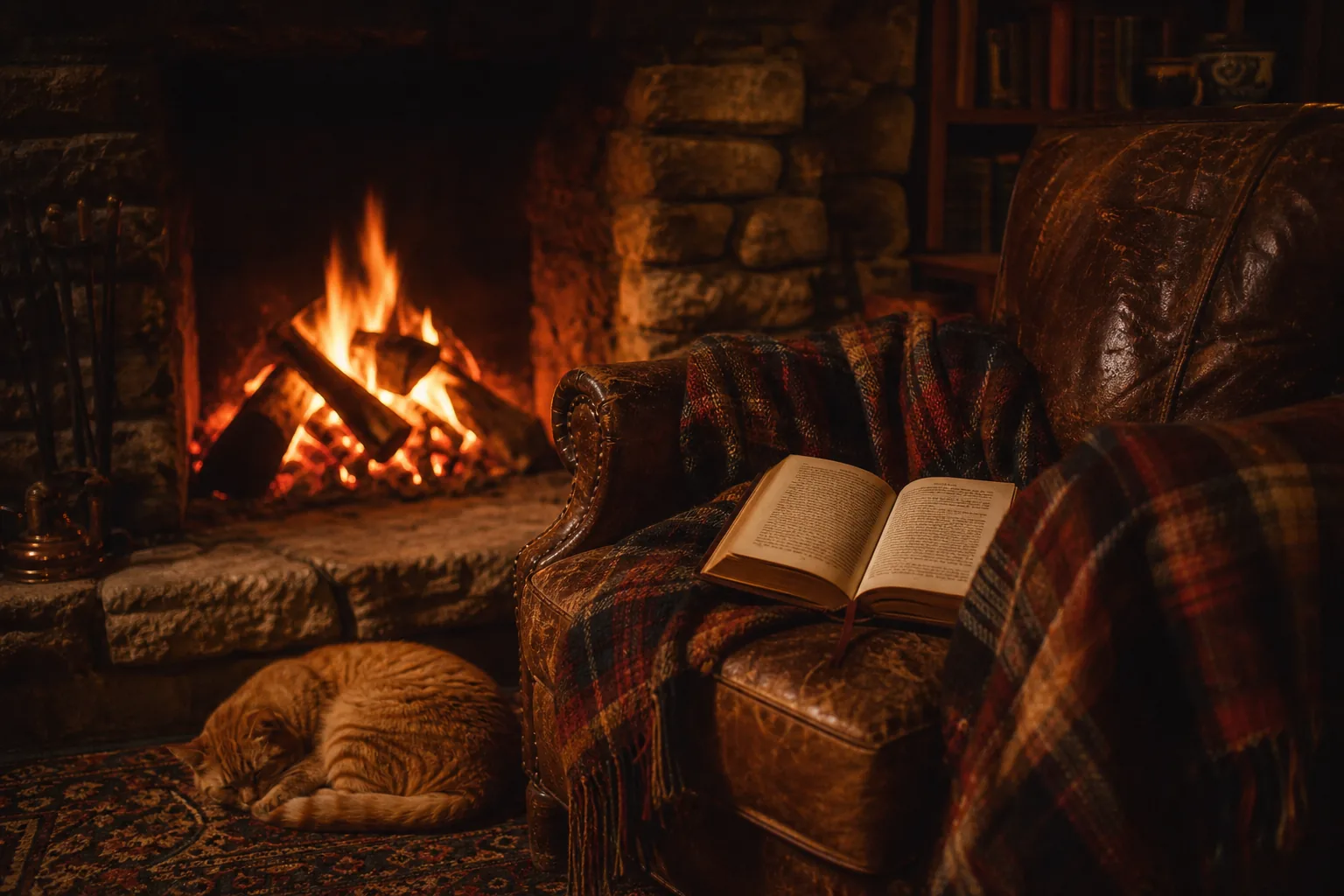
A locked-off wide shot of a stone fireplace at night, large logs aglow with orange and crimson flames. A worn leather armchair sits at right with a tartan blanket draped across it and a leather-bound book open on the seat. A ginger tabby cat is curled on the rug at the chair's base, breathing slow. No people. Nothing in the frame moves on its own except the fire, the cat, and once every twenty seconds the slow rise and fall of the blanket as if someone just left the chair.
Sound is the whole video. A steady crackle of burning wood, occasional pops and small shifts as a log collapses, the sleeping breath of the cat just barely audible on the room tone. Layer in the faintest sound of an old clock ticking somewhere off-camera. No music. No speech.
Loop the video — fire never going out, cat never waking up — so a viewer who leaves it playing for an hour gets sixty minutes of warm room.
Key sound: a continuous wood fire crackling, occasional log collapse, distant clock tick, slow cat breathing. Key visual: stone fireplace + leather armchair + sleeping ginger cat in deep amber light.
9 — Ice crackling in a whiskey glass

The camera lives at eye level with the bar top. A single crystal tumbler sits dead-center holding a large square ice cube and a generous pour of amber whiskey. The room behind is dim, with soft bokeh from distant bar lights. Nothing else is in frame. The video is just this glass for the full duration.
The sound runs three layers. A close mic on the ice catches every hairline crack as the cube settles into the warm liquid — sharp short tnk sounds, then a delayed deeper crack as a fracture widens. A second mic catches the soft hiss of whiskey wetting newly exposed ice. Underneath, a low ambient hum of a quiet bar — no voices, no music, just air and refrigeration. Once or twice, a small shard breaks free and clinks against the glass wall.
End on a slow zoom in to a single fresh crack, glowing amber from inside, and hold for three seconds before cut to black.
Key sound: micro-cracks in ice, whiskey wetting glass, low ambient bar hum. Key visual: a single crystal tumbler with a fracturing ice cube and amber whiskey, dim bar behind.
Travel and nature ASMR loops
The last group works because the viewer is somewhere else. Put them in a window seat, in a cable car, on a porch in the snow — somewhere they can't quite get to in their own afternoon — and let the ambient soundscape carry the rest.
10 — Night train window seat
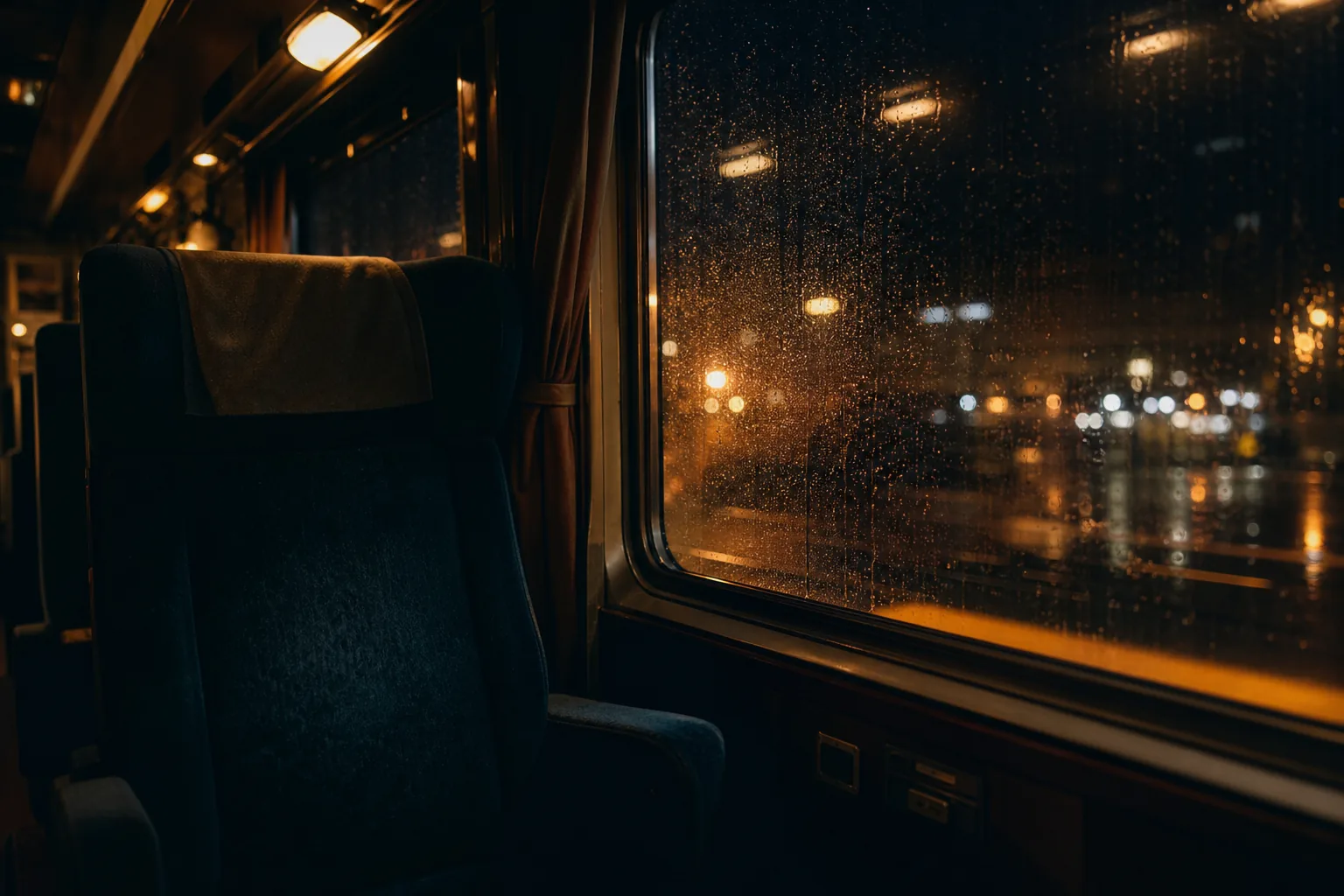
Set the frame inside a night train carriage, camera locked off on an empty velvet window seat. The window beside it is large, black, streaked with rain, and passing amber city lights flash past as soft blurred orbs at regular intervals. A dim overhead reading lamp casts a small pool of warm light on the seat. No people. The carriage is yours alone.
The audio is the rhythm of a moving train. A steady clack-clack, clack-clack of wheels over track joints, slightly muffled by the carriage walls. A faint metallic creak as the carriage rocks side to side. Rain on the window as a high constant patter, with occasional gusts when the train passes a tunnel mouth. No conductor announcements. No music.
Loop the video around the train's rhythm: match a wheel-clack to a city light flash, and have both repeat through the duration. The viewer should feel like they could fall asleep against the window and miss the next stop.
Key sound: rhythmic wheel-on-track clacking, rain on window glass, faint carriage creak. Key visual: an empty window seat in a night train with passing amber lights and rain-streaked glass.
11 — Cable car through snowy mountains
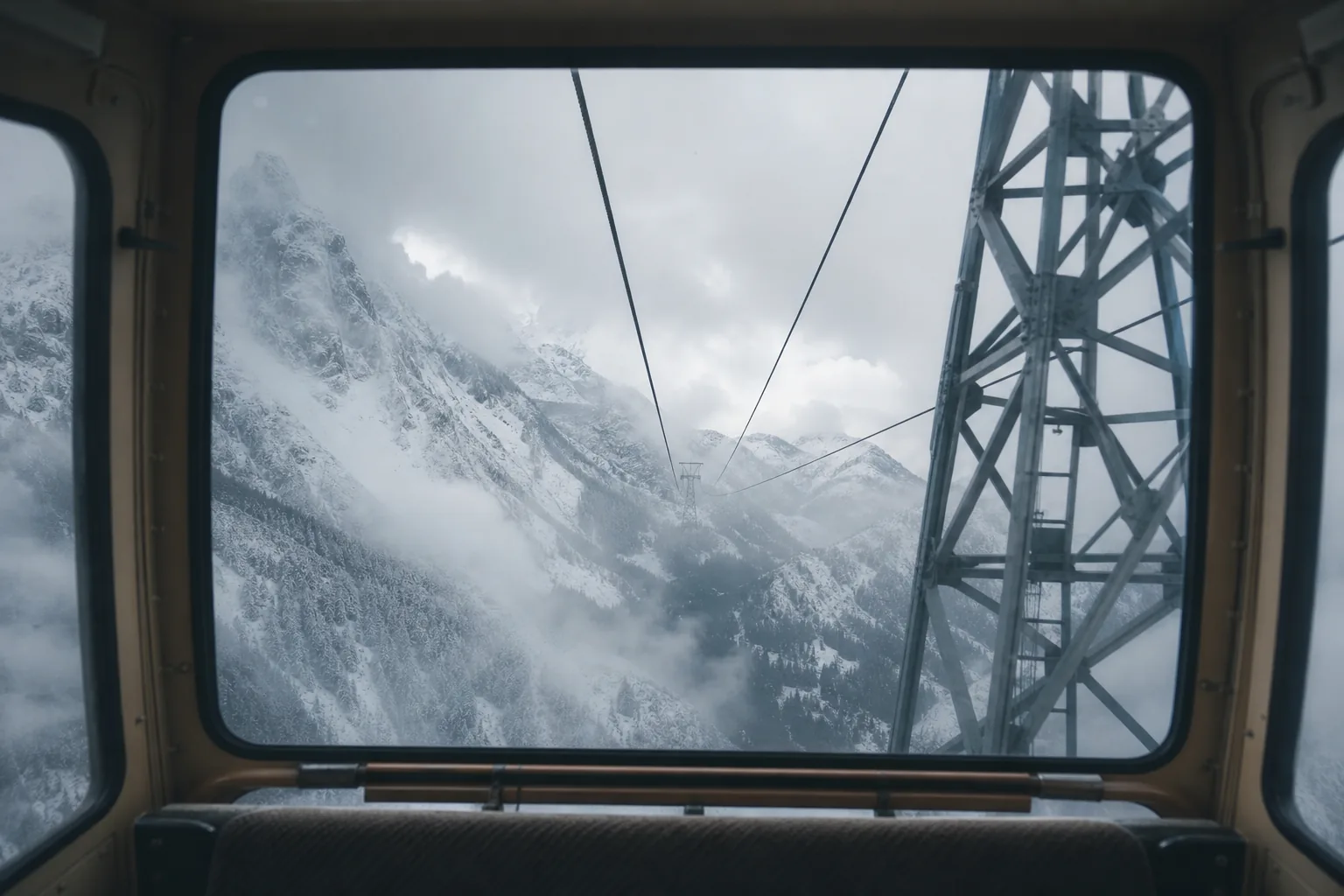
The camera is the gondola. The view is straight out the front window: a misty snow-covered alpine landscape stretching into the white distance, two thick suspension cables disappearing into cloud, and once every fifteen seconds a steel support tower slides past on the right with a sharp metallic shadow across the frame. The light is overcast and cold. Nothing in the cabin is human.
Audio is built from three steady elements. The low constant hum of the cable running through the wheel housing above the cabin. A high thin wind whistling across the gondola's metal frame. A rhythmic thunk every time the cable car crosses a support tower wheel — the soundtrack to "we are still moving forward." No music. No voices.
End by holding on a tower passing — wheel thunk, shadow sweeping across the cabin floor — and cut to black on the shadow's far edge.
Key sound: cable hum overhead, thin wind across metal, rhythmic tower thunks. Key visual: POV through a gondola front window at snowy mountains, a passing steel tower frame.
12 — Cabin porch in light snow
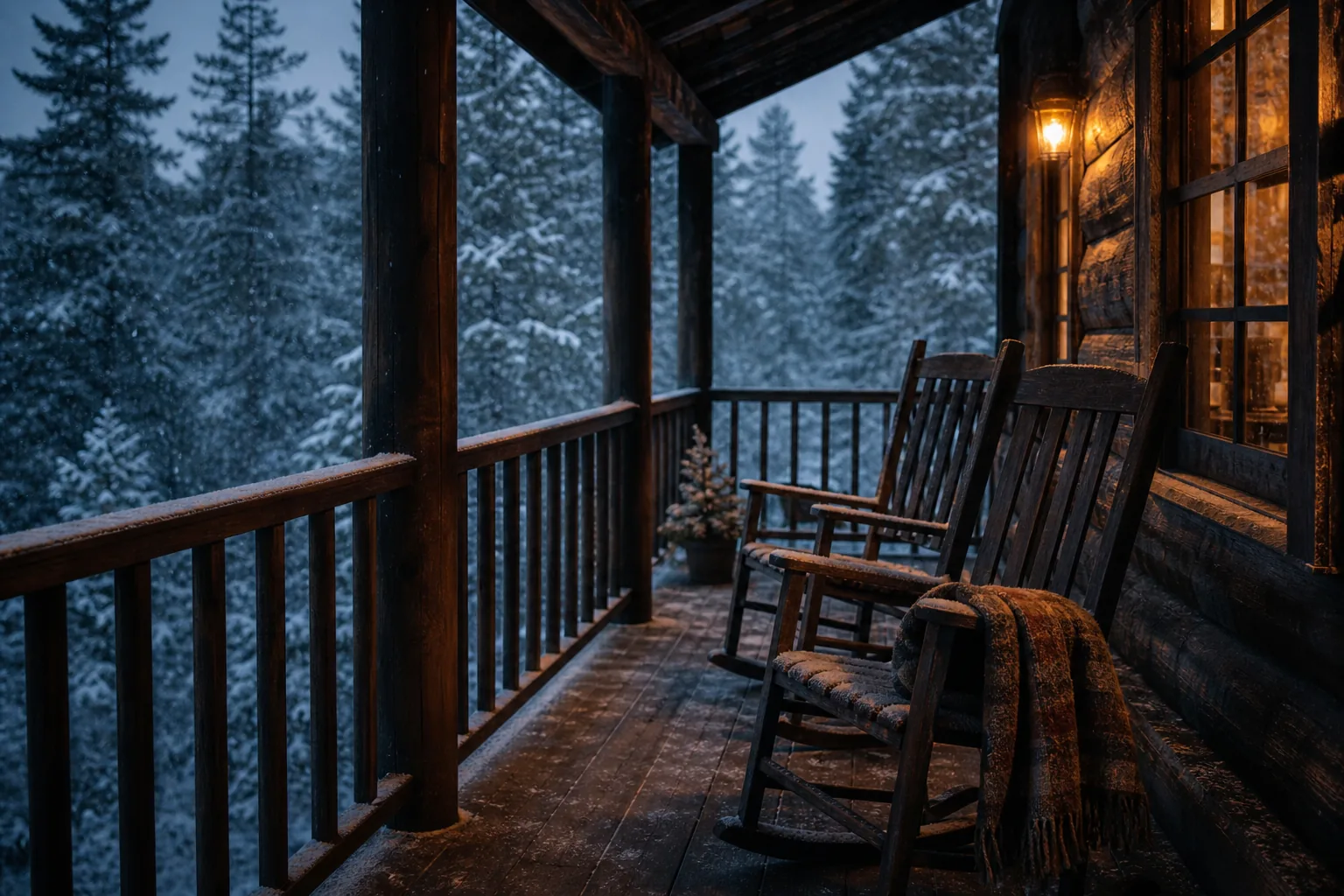
The camera sits on a wide wooden cabin porch at dusk, framing two empty rocking chairs against a snow-dusted pine forest. A folded wool blanket rests on the nearer chair. A warm yellow lantern glow spills from the cabin window behind on the right, lighting the porch boards just enough to see the snowfall. Snowflakes drift down steadily through the frame, never stopping.
Sound is a quiet outdoor evening. A muffled blanket of falling snow on wood and pine needles. The slow creak of one rocking chair shifting with the wind — never moving more than an inch. Far in the distance, an owl calls twice, then nothing. Inside the cabin behind the camera, the faintest crackle of a fire bleeds through the window. No music. No words.
Hold the frame still for the full duration and let the snow do the motion. End on a single large flake landing on the seat of the empty rocking chair, beat of stillness, cut to black.
Key sound: muffled snowfall, slow chair creak, distant owl, faint window-muted fire crackle. Key visual: a snowy cabin porch with two empty rocking chairs and a warm lantern glow.
Twelve formats is enough for a posting calendar that doesn't repeat for three months. Pick the one whose Key sound you can already hear — that's the one that will record cleanest on the first take. If a format feels too long for the platform you're posting on, hold the loop tighter; if it feels too short, lengthen the middle and tighten the ending. The point is to ship one tonight, then come back tomorrow for the next.
Tags
Turn any story into a 60-second video
Story Into Video bundles image generation, animation, narration, and subtitles into one workflow. Free credits cover your first video.
Start creatingTry the tools mentioned in this article
Seedance 2 Story Video Generator
Seedance 2.0: any duration from 4 to 15 seconds, native audio, with image / video / audio reference inputs.
Nano Banana Pro Image Generator
The Gemini 3 image family — photoreal scenes, precise text-in-image and natural-language editing. Pro and Nano Banana 2 available.
Seedream 4.5 Image Generator
Seedream 4.5: story illustration, character sheets, scene concept art — with native Chinese-language prompt support.
Continue reading
12 AI Video Prompts You Can Copy, Paste, and Generate in 2026
Stop staring at a blank prompt box. Twelve AI video prompts with scene-level camera, light, and audio direction — open any one in the editor and ship it tonight.
16 min read
AI Book Trailer Maker: Turn Any Manuscript Into a 60-Second Trailer
A complete 5-step workflow for making a 60-second book trailer with AI, plus six genre formulas you can paste straight into the editor — mystery, romance, thriller, literary, fantasy, and memoir.
12 min read
Horror Story Ideas: 12 Complete Scripts Ready for AI Video
Twelve horror story ideas written as full scripts you can copy directly into Story Into Video — no premise lists, no fragments, every story is a complete narrative ready to film.
15 min read